Remembrance, Peace, and Reconciliation
In September and October 2026 I had the privilege of spending 6 days at the Scuola Di Pace near Marzabotto, Italy. Joining a group of 36 students from across Europe we explored the meaning of memory, the role of remembrance, and discussed what we can do to ensure peace, both today and in the future.
This visited was funded by the Coventry Association for International Friendship (CAIF) and formed part of a body of work completed around the 7th Symposium of the International Cities of Remembrance.
Scuola Di Pace Monte Sole
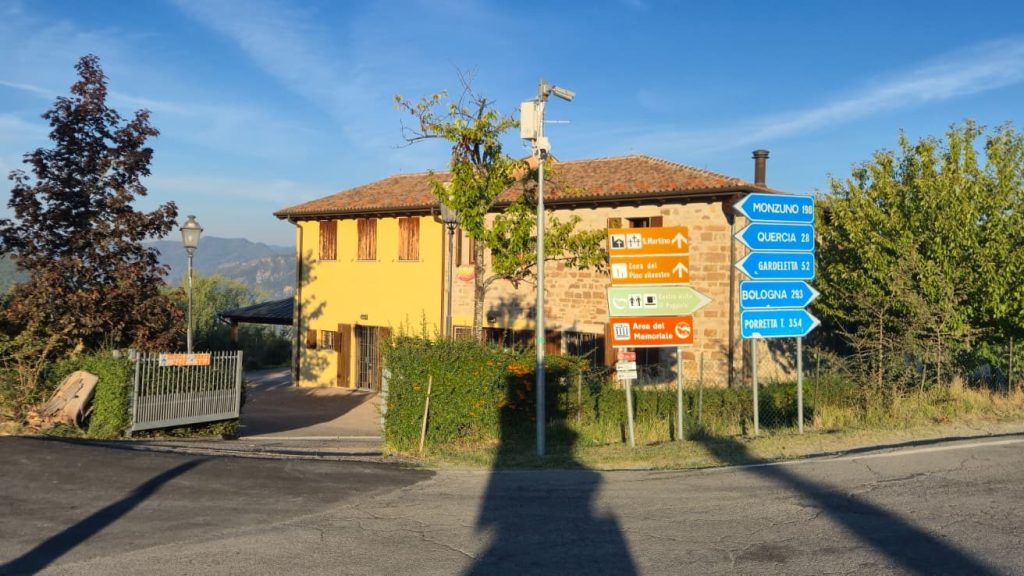
The school of peace served as our accommodation and base during our time in Monte Sole. Sitting against the side of Monte Sole (one of the largest mountains of the Northern Appenines) the school is almost completely isolated. It is near the former village of San Martino and 200m away from the only other property Il Poggiolo Re-esistente (the lodge of the resistance).
It sits at a crossroads in the heart of the Parco Storico di Monte Sole. Prior to the construction of the nearby highway this would have been the road between the local town of Monzuno and the larger city of Bologna, as well as the main route between the Reno and Setta Valleys. It is this route that unfortunately leads to the horrific events that took place between the 29th of September and 5th of October 1944.
Why Monte Sole?
By the summer of 1944 Italy is a country well and truly divided. The King has deposed Benito Mussolini and replaced him with Marshal Pietro Badoglio. Mussolini is arrested, however is freed by Nazi forces. Following a flurry of military activity Italy settles into two distinct zones. In the north the Italian Social Republic is created, with Mussolini as leader propped up by the military force of the Nazi Germany. In the south the King and Badoglio form the Kingdom of the South, supported by the Allied powers.
On the 25th of May 1944 the Allied forces break through the Gustav line and liberate Rome on the 4th of June. They continue fighting north aiming to secure the major ports of Livorno and Pisa, as well as the Tiber Vally and towns such as Perugia and Ancona. As the Nazi forces retreat they begin a systematic programme of destruction, blowing up bridges, destroying railway lines, and collapsing tunnels. This slows down the Allied forces and provides time for the construction of the Gothic line of defences that spread over 200 miles long. With hundreds of gun emplacements, concrete bunkers, and even dug-in tank turrets, the Gothic line ran straight across Monte Sole and the neighbouring Monte Caprara.
The Reno and Setta valleys were essential to the Nazi supply lines, delivering troops and armaments from sites near Bologna straight to the frontline. The local partisans, led by Mario Musolesi (named as Il Lupo – The Wolf), and known as Brigatta Stella Rossa were active in disrupting these supply lines. As the frontline edged nearer to both valleys the partisans are alleged to have shared information on Nazi movements to Allied forces. This leads to a directive being issued to all Nazi commanders along the Gothic line, they must clear their sections of all partisans and will receive protection from Reich if, in doing so, civilians are killed. The directive also states that it is better to be ‘overly cautious’ when clearing partisans, recognising it is better to ensure activity is eliminated than run the risk of further disruption.
As the Allies begin to break through the first parts of the Gothic line Walter Reder, commander of the 16th SS Panzergrenadier Division, devises a plan to clear partisans around Monte Sole and Monte Caprara. This includes the deliberate annihilation of the landscape, removing trees and any destroying any buildings that may obscure Allied troops attacking emplacements along the mountains. Between 1,000 and 1,500 troops are amassed including SS, Wehrmacht and Fascist troops. Wehrmacht troops form a belt around the mountains, whilst Fascist and SS groups are assigned routes to locate and roundup the residents living in the villages and hamlets on the mountains.
The Massacre
Early on the morning of the 29th of September Nazi (predominately SS) troops enter Cadotto and Creda on the South-west slope of the mountains. In Cadotto they encircle farmhouses were it is thought Il Lupo is staying. As the sunrises they begin firing on the farmhouses, killing fourteen partisans before Il Lupo is shot dead as he tried to break through the encirclement. The other civilians in the village are rounded up. 48 people are killed, with Nazi’s officers later testifying that “at least 30 civilians were placed against the wall and shot to death”. South African soldiers report 17 unburied bodies when they reach Cadotto some weeks later.
In Creda another group of SS troops round up all the people staying in the farmhouse and barn. Approximately 90 people are counted in the courtyard, before they are all locked in a barn. Grenades are thrown into the barn before automatic gunfire is directed at the corpses. 69 people die in the barn, whilst 11 people, including eight children and two women are killed in nearby Vallego. Survivors and witnesses to the massacre at Creda later testify that it was directed by a light signal, likely sent once troops reached San Martino di Caprara.
Between 8am and 9am SS troops arrive at Cerpiano and Casaglia. In Cerpiano 49 civilians including 20 children from the local nursery school are rounded up and locked in the Oratorio (church). Similarly to Creda grenades are thrown into the church. 46 people are killed.
In Casaglia approximately 100 civilians, mainly women and children, seek refuge in the church of Santa Maria Assunta. The priest Don Ubaldo Marchioni leads a service for all those seeking refuge. A group of 10 Nazi’s arrive at the church and drive the civilians towards Casaglia cemetery. In the church a paraplegic parishioner is killed, before Don Ubaldo Marchioni is killed at his altar. Two more civilians are killed after being discovered in the bell tower. At the cemetery the civilians are lined up against the wall before machine guns. Hand grenades are thrown at them before machine guns are fired into the bodies. Only 8 wounded children survived.
At an unknown time, likely between 9am and 10am the Nazi’s enter San Martino di Caprara and Poggiolo. Here the Nazi’s shoot 18 people at point-blank range, before setting their farmhouses on fire. Don Ferdinando Casagrande, a bedridden priest, is killed alongside his sister in their home.
After 9am the Nazi troops roundup the civilians in Casoncello and take them away. At 11am all enter the conjoined hamlets of San Giovanni di Sotto and San Giovanni di Sopra. Alarmed by the distant sound of shooting, the local residents in San Giovanni had hidden in an air raid tunnel. Solders drove them out of the tunnel and gathered them with the civilians from Casoncello, in front of a barn wall. 52 people are killed, including nineteen children under the age of 13.
By midday an SS unit has made its way from Casaglia to Caprara. Caprara was the historic municipal centre for the area until it was moved to Marzabotto in the late nineteenth century. Despite its dwindling status the village was still well populated, being home to 13 families, a tavern, and a chemists. For those living on the hill Caprara also served as an important meeting place, with the village square often being used for dances and celebrations. Earlier in the morning eight members of the Tondi family had been killed in woods near Caprara, whilst Nazi documents show that at least one Luftwaffe Officer had been killed in a similar location. The SS rounded up the civilians left in Caprara and led them into the kitchen of the tavern. Again grenades were thrown into the building before machine guns were used to kill any survivors. 35 people are killed in the tavern, including 3 partisans and all 7 children of the Lubini family, who had previously fled Villa D’Ignano.
During the afternoon and evening some of the wounded begin to come to consciousness. In some cases they make their own way to safety, in other cases family members or unknown civilians find them and help them to safety.
On the 30th of September the Nazi’s return to Cerpiano and San Martino. In Cerpiano the Nazi’s decide to turn the complex including the church into a command post. They arrive at the Oratorio and kill any remaining survivors. In San Martino a group of thirty-seven people including the Lorenzini, Luccarini and Paselli families are pulled from their homes and hiding places and killed. Homes and livestock are set on fire.
In Roncadelli 16 are killed as the SS encircle the farmhouses. In Pioppe di Salvaro 500 local men who have been captured are being kept in a hemp factory. After interrogation from the SS at least 45 men who are deemed unfit, sick, or older are taken to the factory’s water reservoir and killed, their bodies falling into the factory mechanisms.
For some of the injured, or for the families of those who did not make it, Ca’ Beguzzi provides shelter from the Nazi atrocities. On the 4th of October SS troops discover an unknown number (>30) of people hiding in the cellar of a building. The men are separated into two groups and forced to work digging gun emplacements and preparing the few remaining properties for billeting. 18 women, children, and elderly people are killed in the cellar. The men are taken to the edge of a cliff and shot. Only a few survive.
All told 770 civilians are killed during the 6 day operation in Monte Sole. Records and research suggest that the killings were spread across 125 individual sites. It is the largest massacre of civilians in Western Europe during the Second World War, perpetrated on a site that spans over 6,300 hectares (64sq km).

